
Poor territory management is one of the most common and most preventable sources of inefficiency in field sales teams. When zones aren't clearly defined, reps overlap, managers lose visibility, and you end up with some areas being knocked three times while others go untouched.
A well-structured territory system solves all of this. It ensures comprehensive market coverage, eliminates rep conflicts, and gives managers the data they need to optimize performance over time.
This guide covers everything you need to know to build and manage sales territories for your field team.
Why Territory Management Matters
Coverage without overlap Each door should be knocked by exactly the right person at the right time. Overlap wastes rep time and leaves prospects with a bad impression of your organization.
Fair workload distribution If some territories are significantly larger or more competitive than others, you're setting reps up for unequal outcomes. Good territory design accounts for potential, density, and travel time.
Accountability and measurement When each rep owns a defined zone, their performance data is meaningful and comparable. You can identify which territories are underperforming and diagnose whether it's a rep issue or a territory issue.
Scalability As your team grows, well-defined territories make it easy to split zones, reassign areas, and onboard new reps without disrupting the whole operation.
How to Design Sales Territories
Territory design is part science, part art. Here's a systematic approach:
1. Define your coverage area Start with the total geographic area you want to address in a given campaign. This might be a city, a set of postal codes, or a defined radius from a central location.
2. Segment into logical zones Divide the coverage area into zones that are:
- Roughly equal in potential (number of households, businesses, etc.)
- Geographically logical (following streets, neighborhoods, or postal boundaries)
- Practical to work in a single day or shift
Avoid arbitrary divisions that force reps to cross major roads or travel long distances between parts of their zone.
3. Assess zone difficulty Not all zones are equal. Consider:
- Housing density (apartments vs. detached homes)
- Income demographics (relevant for your product)
- Historical conversion data if you've worked the area before
- Travel time within the zone
Adjust zone size to account for difficulty — a dense urban zone can be smaller; a sparse suburban zone may need to be larger to give the rep enough potential.
4. Assign zones to reps Match reps to zones based on:
- Experience level (put senior reps on tougher territories)
- Physical proximity (reduce commute where possible)
- Language or cultural fit (in diverse markets)
5. Document everything Every rep should have a written zone definition with a map. Ambiguity is the enemy of territory management.
Managing Territories in the Field
Designing territories is the easy part. The real challenge is managing them day-to-day as conditions change.
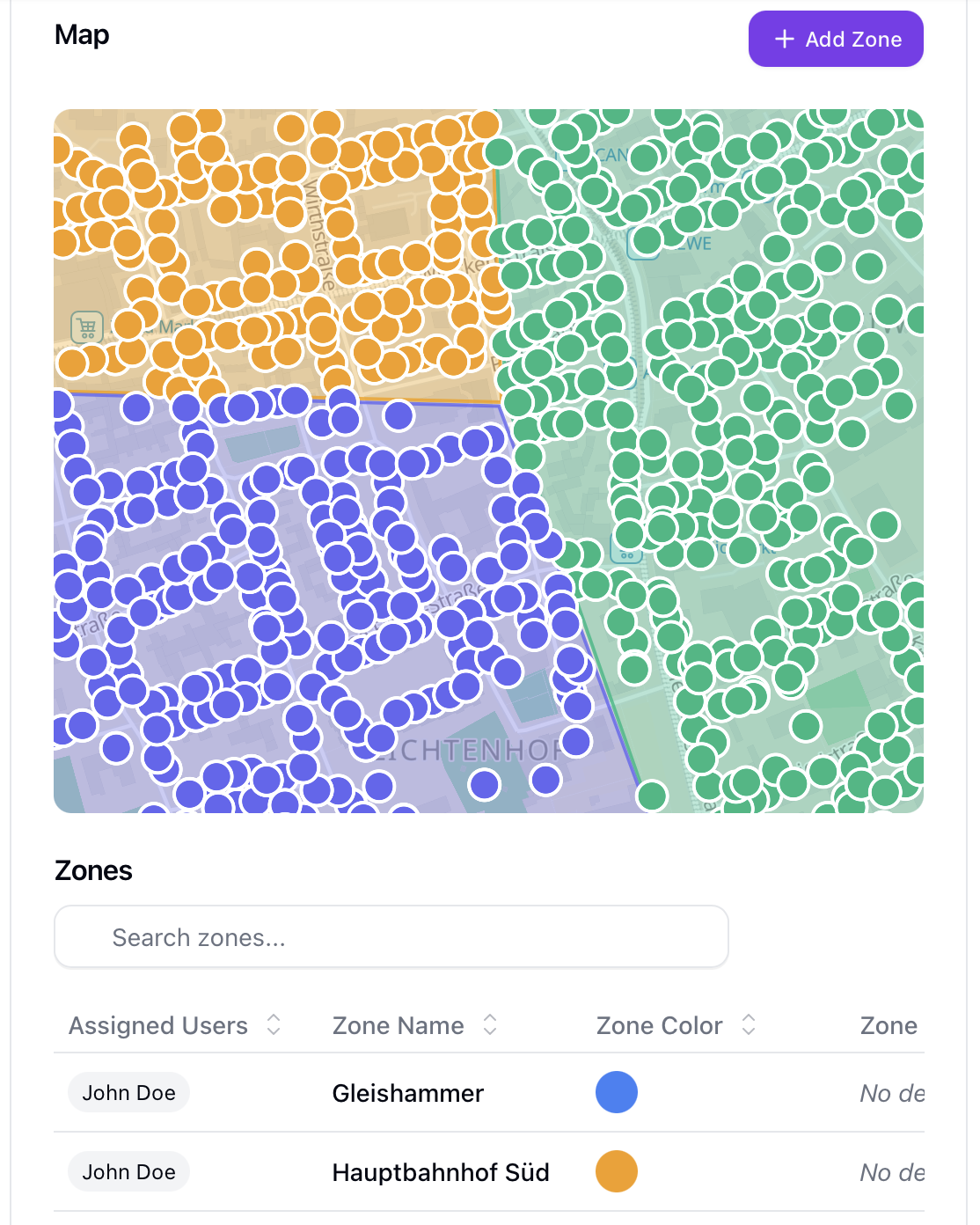
Track coverage, not just sales A rep might close zero deals in a day but have knocked 80 doors — that's productive. Or they might have knocked 10 doors and reported 80. Track door-by-door activity to see what's actually happening.
Review territory performance weekly At the end of each week, review:
- Coverage percentage (what portion of the zone was actually worked?)
- Conversion rate by zone (is the territory performing to expectations?)
- Time-per-door (are reps moving efficiently?)
This data tells you whether underperformance is a rep issue (low activity, low conversion relative to activity) or a territory issue (low conversion despite normal activity).
Rotate territories periodically Rotating reps through different territories has two benefits: it prevents "zone fatigue" where reps become complacent about their home area, and it gives you richer performance data across the whole team.
React to market changes A new competitor, a local news story, a major employer closing — all of these can affect how territories perform. Stay close to the data and be willing to adjust zone assignments or approaches when the market shifts.
Common Territory Management Mistakes
Mistake 1: Territories that are too large When a zone is too big to cover in a week, reps cherry-pick the easiest streets and leave the rest untouched. Keep zones to a size that can be fully worked in a manageable timeframe.
Mistake 2: No clear zone boundaries Fuzzy boundaries lead to overlap and rep conflicts. Every zone edge should be a specific street, postal boundary, or geographic feature — not a rough approximation.
Mistake 3: Setting territories and forgetting them Markets change. Team composition changes. Territories need to be reviewed and adjusted regularly, not just set at the start of a campaign and left alone.
Mistake 4: No tracking within zones Assigning a zone to a rep is not the same as managing that zone. Without tracking which specific streets and addresses have been worked, you have no visibility into actual coverage.
How SellFaster Makes Territory Management Simple
SellFaster gives field sales managers a complete territory management system built into their sales platform:
- Visual zone assignment — create and assign geographic zones on a map interface
- Real-time rep tracking — see which zones are active and where reps are working
- Door-by-door logging — every interaction is recorded against its address, giving you full coverage visibility
- Performance by zone — compare conversion rates across territories to optimize assignments
- Campaign-level organization — manage multiple products or campaigns with separate zone configurations
Instead of juggling map screenshots and spreadsheets, everything lives in one place — accessible to managers and reps alike.