
Managing a door-to-door sales team is one of the most demanding jobs in sales leadership. Your reps are scattered across neighborhoods, working autonomously, and results can vary wildly from one person to the next. Without the right systems in place, it's easy to lose visibility, miss performance issues, and watch your best reps burn out.
This guide covers the proven strategies that experienced D2D sales managers use to keep their teams organized, motivated, and consistently hitting targets.
1. Establish Clear Sales Zones from Day One
Territory confusion is one of the biggest sources of friction in door-to-door teams. When two reps knock the same street, you waste time, annoy prospects, and create internal conflict.
How to do it right:
- Define geographic zones before each campaign starts
- Assign one rep (or team) per zone — no overlaps
- Review zone assignments weekly and adjust based on conversion data
- Use visual maps so every rep knows exactly where they're working
When zones are clearly defined, reps take ownership of their territory and you get clean, comparable performance data.
2. Set Measurable KPIs for Field Reps
You can't manage what you can't measure. For D2D teams, the right KPIs go beyond just "sales closed." Track the full funnel:
- Doors knocked — the baseline activity metric
- Contacts made — how many people actually answered
- Pitches delivered — how many sat through the presentation
- Conversion rate — closed deals / pitches delivered
- Revenue per door — efficiency metric for campaign ROI
When every rep knows which numbers matter, they self-manage more effectively and you have objective data for coaching conversations.
3. Run Daily Check-Ins (but Keep Them Short)
Field reps work alone most of the day. A brief daily sync keeps them connected to the team and surfaces problems before they compound.
A 10-minute daily standup structure:
- What did you accomplish yesterday?
- What's your plan for today?
- Any blockers or help needed?
Do this over a team channel or a quick video call. The goal isn't to micromanage — it's to maintain momentum and catch issues early.
4. Use Real-Time Tracking to Stay Informed Without Micromanaging
The best D2D managers know where their team is without constantly calling to ask. Real-time sales tracking tools let you see which zones are active, which reps are on pace, and where the team is falling behind — all without disrupting field work.
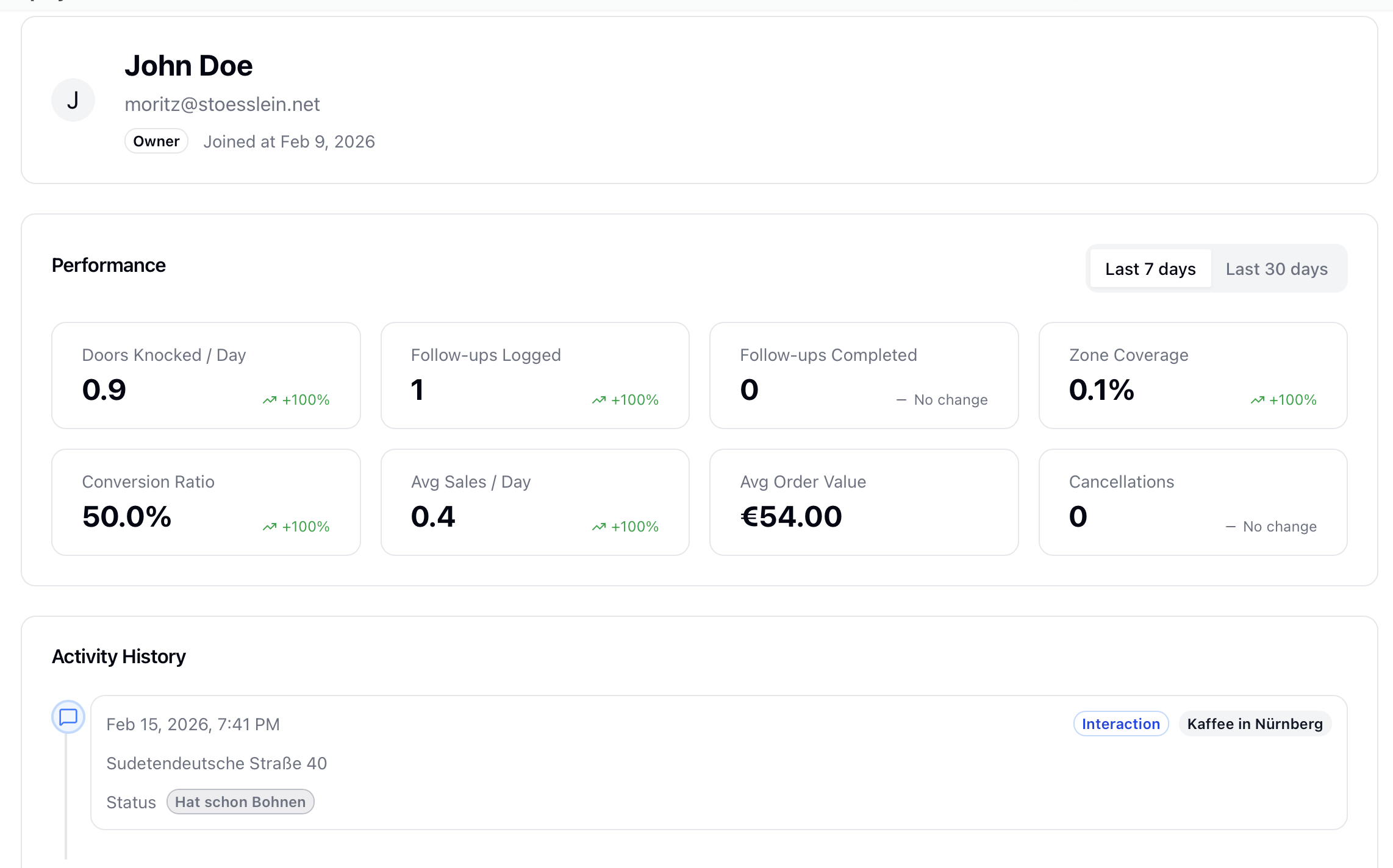
With a tool like SellFaster, managers can:
- View live activity across all assigned zones
- See door-by-door logs as reps record interactions
- Spot which territories are underperforming and intervene early
- Access full interaction histories for coaching sessions
This gives you the visibility of being in the field yourself — without leaving the office.
5. Motivate with Transparent Commission Structures
Nothing demotivates a sales rep faster than commission confusion. If reps don't trust the numbers, they disengage.
Principles for commission that motivates:
- Keep it simple — reps should be able to calculate their own earnings mentally
- Pay fast — delays between sale and commission kill motivation
- Show the math — provide a detailed commission slip after every payout cycle
- Add bonus tiers — extra reward for reps who exceed targets
SellFaster automates commission slip generation, so reps always see exactly what they've earned and how it was calculated. Transparency builds trust, and trust drives performance.
6. Coach Based on Data, Not Gut Feeling
The most common management mistake in D2D is confusing "loud and confident" with "good." Some of your best performers are quiet and methodical. Some of your loudest reps are burning goodwill and generating chargebacks.
Use your data to identify:
- Reps with high door-knock counts but low conversions → pitch training needed
- Reps with high conversions but low activity → motivation or route issue
- Reps with high activity AND high conversions → study their approach and replicate it
Schedule bi-weekly 1:1 coaching sessions. Come with the numbers. Let the data lead the conversation.
7. Build a Culture of Accountability Without Fear
High-performing D2D teams have one thing in common: everyone holds everyone else accountable. That culture starts with you.
- Share team KPI dashboards so performance is visible to the whole team
- Celebrate wins publicly
- Address underperformance privately, early, and specifically
- Set clear consequences for repeated issues — and follow through
When people know what's expected and see that expectations apply to everyone equally, accountability becomes cultural rather than managerial.
Bring It All Together with the Right Tool
Managing a door-to-door sales team is fundamentally an information problem. The managers who succeed are the ones who have clear, real-time visibility into what their team is doing and can act on that information quickly.
SellFaster was built specifically for D2D and field sales teams. It combines territory management, real-time activity tracking, performance dashboards, and automated commission calculations in one platform — so you spend less time chasing information and more time coaching your team to win.
Ready to see how SellFaster can transform your D2D team management? Try SellFaster today.